
Crushing It: The Indispensable Role of Concrete Compress Testers
You know, when we talk about impressive feats of engineering, we often think of towering skyscrapers or monumental bridges. But what holds it all up, quite literally? Concrete, of course! And how do we ensure that concrete is up to the job? Well, that's where the trusty Concrete Cube Compress Testing Machine comes into play. To be honest, it’s one of those unsung heroes of the construction world, but absolutely critical for safety and structural integrity.
Why Compressive Strength Matters So Much
In the simplest terms, a Concrete Cube Compress Testing Machine measures how much force a concrete sample can withstand before it, shall we say, fails spectacularly. This isn't just an academic exercise; it's about predicting how a building, a bridge, or a highway will behave under pressure. If your concrete isn't strong enough, the consequences can be catastrophic. Many customers, especially those in civil engineering, emphasize that consistent testing is their first line of defense against future liabilities.
The Nitty-Gritty: How a Test Unfolds
So, how does it all work? It's a surprisingly precise process. First, you've got your concrete cubes, typically 150mm x 150mm x 150mm, cured for a specific period (usually 7, 14, or 28 days) according to standards like the national standard “ordinary concrete mechanical properties test method standard.”
· Preparation: The cured concrete cube is carefully placed between the upper and lower pressing plates of the Concrete Cube Compress Testing Machine.
· Loading: The machine, often driven by a robust hydraulic power source, begins to apply a controlled compressive force. Modern machines allow for manual control of loading speed, which is crucial for accurate results.
· Data Collection: An intelligent measuring and controlling instrument continuously collects test data. It monitors the applied force and displays the loading speed, often in real-time.
· Peak Maintenance & Failure: The machine maintains the peak force achieved before the concrete sample fractures. It also usually includes overload protection functions, which is a neat safety feature, I guess.
· Calculation: Finally, the instrument processes the data and converts the maximum force into the concrete's compressive strength, usually expressed in MPa or psi.
Key Specifications for a Robust Machine
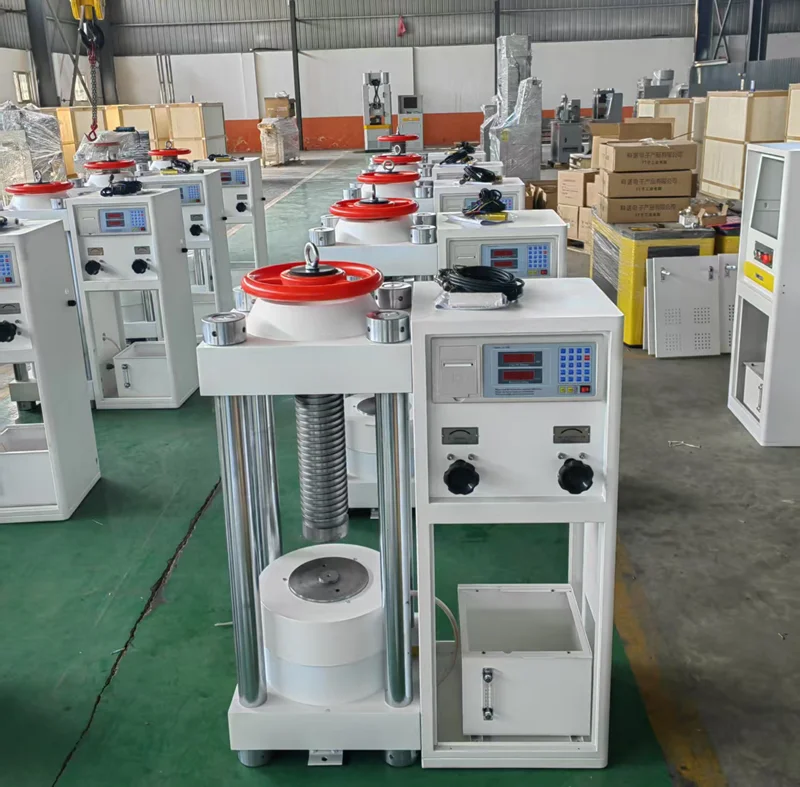
When you're looking at a Concrete Cube Compress Testing Machine, certain specs really stand out. For instance, a 2000KN capacity machine is a workhorse, suitable for a vast range of concrete strengths. Here's a look at what a typical high-performance unit offers:
Feature | Specification (2000KN Model) |
Maximum Test Force | 2000kN |
Testing Machine Level | 1 Level |
Relative Error of Test Force Indication | ±1% within (real-world use may vary slightly) |
Host Structure | Four column frame type |
Piston Stroke | 0-50mm |
Compressed Space | 320mm |
Upper Pressing Plate Size | 240×240mm |
Lower Pressing Plate Size | 250×350mm |
Overall Dimensions | 900×400×1250mm |
Overall Power | 1.0kW (Oil pump motor ≈0.75kW) |
Overall Weight | 700kg |
Voltage | 380V/50HZ |
Where You'll Find These Machines at Work
It's not just a lab curiosity, oh no. The Concrete Cube Compress Testing Machine is a staple in various industries:
· Construction & Building Materials: This is the obvious one. Every major construction project, from high-rises to residential complexes, relies on these tests for quality assurance.
· Highway & Bridges: Critical infrastructure absolutely demands the highest standards. The durability and strength of concrete used here are literally life-saving.
· Research & Development: New concrete mixes, sustainable materials, and additive studies all require precise compressive strength data.
· Education: Engineering universities use them extensively for hands-on learning and research projects.
Industry Trends and Vendor Considerations
Actually, the industry is seeing some interesting shifts. There's a push for more automated systems, better data integration, and surprisingly, more compact designs that don't compromise on testing capabilities. When choosing a Concrete Cube Compress Testing Machine, you're not just buying a piece of equipment; you're investing in reliability and compliance. Things like calibration services, software interfaces, and long-term support are super important.
A Quick Vendor Comparison (Hypothetical)
Feature | Vendor A (e.g., CZLab) | Vendor B | Vendor C |
Max Test Force | 2000kN | 1000-3000kN (modular) | 1500kN |
Data Logging & Software | Intelligent digital display, PC connectivity | Advanced software, cloud backup | Basic digital display |
Calibration & Support | Comprehensive, long-term support | Standard 1-year warranty, paid extensions | Limited regional support |
Customization Options | Available for specific needs | Limited | Rarely offered |
Customization is another big one. Sometimes, a standard machine just won't cut it for a specialized research project or an unusual material. Many reputable manufacturers, including the one whose product we're discussing, offer options for customized platens or software adjustments to meet these unique requirements. It's definitely worth asking about!
The Bottom Line
In fact, the importance of a reliable Concrete Cube Compress Testing Machine can't be overstated. It’s an essential testing equipment for construction, building materials, and infrastructure projects, ensuring everything from a small building to a massive bridge stands strong against the forces of nature and time. Its service life, when properly maintained, can span decades, making it a sound long-term investment for any serious engineering or construction firm.
So next time you marvel at a concrete structure, take a moment to appreciate the unsung hero that confirmed its strength: the humble, yet powerful, concrete compression testing machine. It literally crushes it, so our buildings don't!
Authoritative Citations
1. ASTM C39/C39M-21, Standard Test Method for Compressive Strength of Cylindrical Concrete Specimens. ASTM International, 2021.
2. EN 12390-3:2019, Testing hardened concrete - Part 3: Compressive strength of test specimens. European Committee for Standardization, 2019.


