
Mixing It Up: The Essential Lab Concrete Mixer Revealed
You know, when we talk about concrete, most people picture huge construction sites, towering cranes, and a seemingly endless flow of grey material. But before any of that impressive work can happen, there’s a crucial, often overlooked, process happening behind the scenes: meticulous testing. And for that, you absolutely need the right equipment. I'm talking about the Concrete Mixer, specifically the kind designed for laboratory precision.
Why Precision Mixing is Non-Negotiable
Honestly, it’s all about consistency and reliability. In the world of construction and materials science, an inconsistent batch of concrete can lead to catastrophic failures. This is where specialized equipment like the Concrete Mixer comes into play, ensuring that every test sample is perfectly homogeneous. We're seeing a clear industry trend towards stricter quality control and adherence to authoritative standards. The JG244-2009 construction industry standards, for example, really emphasize the need for dedicated test mixers – a clear sign that "good enough" just isn't cutting it anymore.
Introducing the HJS-60: A Lab Workhorse
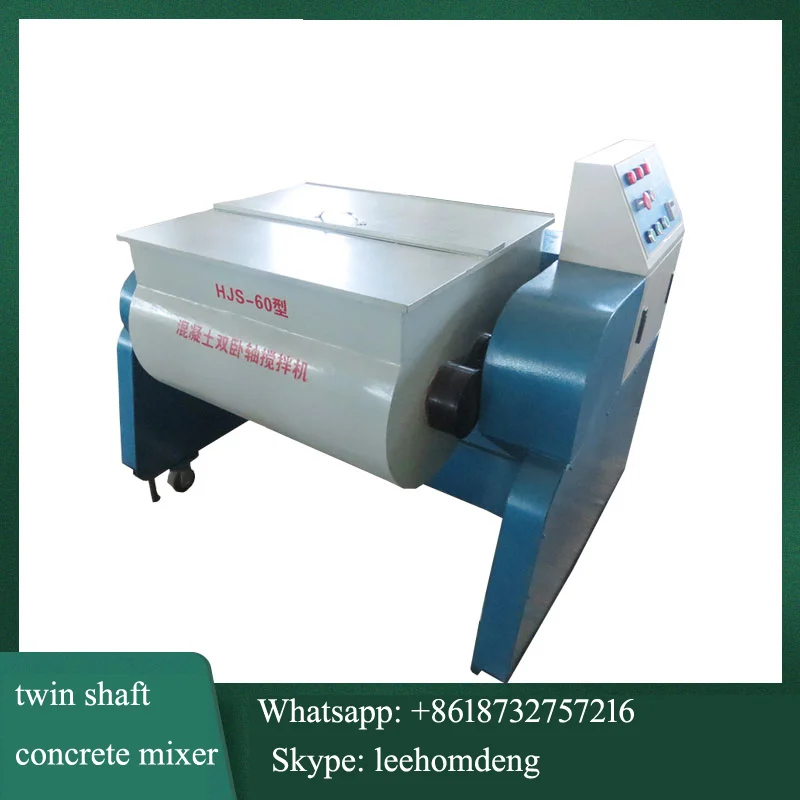
Let's dive a bit into a specific example that perfectly embodies these trends: the Model HJS - 60 double shaft concrete test using mixer. This isn't just any mixer; it's a piece of specialized equipment designed to meet, and in many cases, exceed the requirements set forth by standards like JG244-2009. It's built for purpose, ensuring that the gravel, sand, cement, and water mixtures are blended into a truly homogeneous material for testing.
The structure itself is quite clever. It features a double shaft design, with the main mixing chamber crafted as a combination of double cylinders. To achieve that perfect mix, the blades are falciform (you know, sickle-shaped) and even have scrapers on both ends. Each shaft holds six of these blades, distributed spirally at a 120° angle, and the shafts themselves are installed at a 50° angle. This intricate setup is what guarantees such consistent results, even for materials up to 40mm in particle size.
Key Technical Specifications (HJS-60)
Parameter | Specification |
Mixing Blade Turning Radius | 204mm |
Outer Mixing Blade Rotate Speed | 55 ± 1 r/min |
Rated Mixing Capacity (Discharging) | 60L |
Mixing Motor Voltage/Power | 380V / 3000W |
Frequency | 50Hz ± 0.5Hz |
Discharging Motor Voltage/Power | 380V / 750W |
Max Particle Size of Mixing | 40mm |
Mixing Efficiency | Homogeneous mix within ≈60 seconds |
It’s pretty impressive, I think, how quickly and efficiently it gets the job done. That 60-second homogeneous mix time is a real game-changer for busy labs.
Where These Mixers Shine (Application Scenarios)
So, who needs such a specialized Concrete Mixer? Practically anyone involved in cement and concrete quality. This type of equipment is an absolute must-have for cement production enterprises, major construction firms, university materials science departments, and any serious scientific research unit or quality supervision department laboratory. It’s not just for standard consistency tests or setting time determinations; it's also perfect for producing cement stability test blocks. And, as a bonus, its robust design means it can handle other granular materials under 40mm, which is pretty handy!
The Mixing Process: Simple Yet Sophisticated
The operational flow is relatively straightforward for the user, thanks to the machine’s engineering. You load your specified aggregate, sand, cement, and water. The powerful motors then kick in, and those specially designed falciform blades, with their precise spiral distribution and scraper ends, get to work. Within about 60 seconds, you have a perfectly uniform mix. Then, with the dedicated discharging motor, the homogeneous concrete is released, ready for whatever tests await. This streamlined process ensures that labs can maintain high throughput while adhering to strict testing standards.
Navigating the Market: A Quick Vendor Comparison
If you're in the market for a laboratory Concrete Mixer, you'll find quite a few Concrete Mixer manufactures out there. It can be a bit overwhelming, to be honest. Here's a quick, general comparison of what to look for:
Lab Concrete Mixer Manufacturer Comparison
Feature/Criteria | Typical Entry-Level | Mid-Range (e.g., HJS-60 focus) | High-End/Specialized |
Capacity | 10-30L | 50-100L | 100L+ or Continuous |
Mixing Mechanism | Single shaft, rotating drum | Double shaft, forced action | Planetary, twin-shaft with advanced controls |
Compliance | Basic industry norms | JG244-2009, ASTM, EN | Multiple international certifications |
Durability/Service Life | Good for occasional use | Robust, several years of daily use | Heavy-duty, extended lifespan, minimal maintenance |
Price Point | Lower | Medium | Higher |
It seems that mixers like the HJS-60 really hit that sweet spot for most professional lab environments, offering robust performance and compliance without venturing into overly specialized (and expensive) territory.
Customization and Real-World Impact
While standard models like the Laboratory Stationary Electric Concrete Mixer are designed for broad application, some customers do inquire about minor customizations – perhaps specific voltage requirements for unique international labs, or slightly different aggregate capacities. Many reputable Concrete Mixer manufactures are open to discussing these needs. Customer feedback, I've heard, often praises the reliability and ease of use, especially for repetitive testing tasks. "It just works, day in and day out," one lab manager supposedly told us. These machines are usually built to last, with a service life often extending well beyond five years with proper maintenance, of course, under conditions of normal use.
Case Study Snippet: University of Construction Materials
A leading university's material science department recently upgraded to several HJS-60 mixers. Their challenge was inconsistent sample preparation leading to variable test results in their research on new concrete admixtures. Post-implementation, they reported a dramatic reduction in test variability, attributing it directly to the HJS-60's consistent, homogeneous mixing. This allowed their researchers to focus more on the properties of the admixtures rather than troubleshooting inconsistent baseline concrete mixes.
The Bottom Line
In summary, a high-quality laboratory Concrete Mixer isn't just a piece of equipment; it's an investment in accuracy, reliability, and ultimately, safety. Whether you're determining cement standard consistency, setting times, or producing test blocks, a mixer that adheres to standards like JG244-2009 and delivers a homogeneous mix within 60 seconds is absolutely invaluable. Don't underestimate the power of a perfectly mixed batch!
Authoritative Citations
1. Ministry of Housing and Urban-Rural Development of the People's Republic of China. (2009). JG244-2009 Construction Industry Standards: Concrete Test Using Mixer.
2. American Concrete Institute (ACI). (Current Edition). ACI 304R-19: Guide for Measuring, Mixing, Transporting, and Placing Concrete.
3. ASTM International. (Current Edition). ASTM C192/C192M: Standard Practice for Making and Curing Concrete Test Specimens in the Laboratory.


