
The Silent Guardian: Precision in Every Cement Cure
You know, when we talk about the longevity and strength of concrete, everyone immediately thinks of the mix design, the aggregates, the water-cement ratio. And yes, those are absolutely critical. But, if you ask any seasoned engineer or quality control specialist, they'll tell you something often overlooked, yet equally vital: the curing process. It's the unsung hero, really. And this is where a truly reliable Cement Curing Tank becomes indispensable.
Why We Can't Skimp on Curing: Industry Trends & Standards
Honestly, the industry is constantly pushing for higher performance and greater durability in construction materials. This isn't just about building faster, but building better and smarter. Proper cement curing isn't just a recommendation anymore; it's a fundamental requirement, often mandated by international standards like ISO. We're talking about controlling temperature and humidity meticulously to ensure optimal hydration, which directly impacts the cement paste's strength development and long-term resilience. I mean, who wants a structure that cracks prematurely, right? That's why the focus on precise, automated curing equipment has really picked up steam.
Unpacking the Modern Cement Curing Tank: Features & Functionality
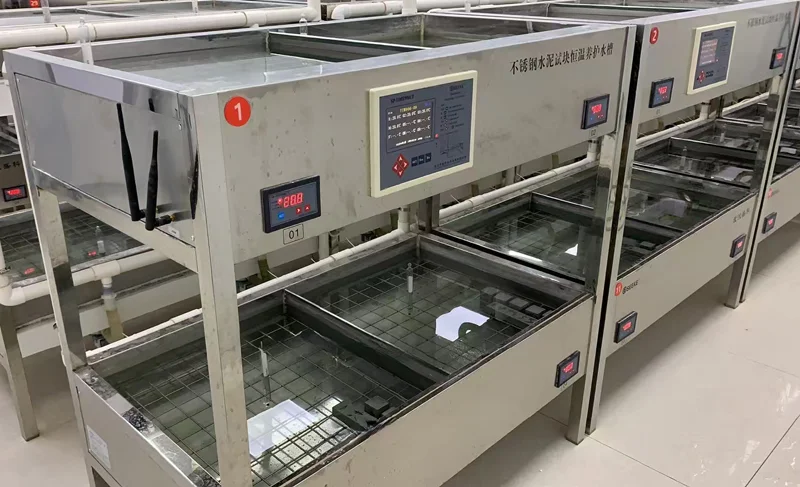
Let's get down to brass tacks. A modernToday's sophisticated Cement Curing Tank is far more than just a water bath. It’s a precision instrument. Typically, these units are crafted from stainless steel, which, to be frank, is essential for resisting corrosion and maintaining water purity over years of continuous use. The primary goal? To provide a stable, constant temperature environment for cement test blocks, exactly as required by those stringent ISO international inspection standards.
The best ones, like the `laboratory stainless steel cement curing water bath tank` many professionals are using, feature advanced temperature display and control systems. They even have compensation heating to counteract any minor fluctuations, ensuring that temperature requirement value of 20.0℃±1℃ is held with impressive accuracy – we're talking fluctuations often kept within ≤±0.5℃! And get this: the latest models can wirelessly connect to a computer via USB, offering data acquisition software. This means you can collect, edit, save, and print data for ten years. Talk about traceability and peace of mind!
Technical Specifications at a Glance
Feature | Specification |
Capacity (Specimens) | ≈90 standard specimens per tank (2 tanks per layer, 2 layers total) |
Power Supply | 220V/50Hz, 500W |
Target Temperature | 20.0℃ ±1℃ |
Temperature Fluctuation | ≤±0.5℃ (typically even tighter in real-world use) |
Temperature Display Error | ±0.5℃ |
Data Record Retention | Up to 10 years |
Application Scenarios & Industries Benefiting
So, who actually uses these sophisticated machines? Primarily, we're talking about quality control laboratories in cement plants, construction companies, university research facilities, and independent material testing labs. Anywhere the exact strength and performance of cement needs to be verified, a reliable Cement Curing Tank is crucial. Industries like civil engineering, building construction, and infrastructure development simply can't operate without these controlled testing environments. Think bridges, skyscrapers, dams – their structural integrity often starts with a perfectly cured test cube!
Customization and Choosing Your Cement Curing Tank Manufacturer
One size doesn't fit all, right? That’s why many manufacturers, recognizing varying workloads, offer customization. You can often find tanks made into three-layer six-grid, three-layer nine-grid, or even three-layer twelve-grid configurations. This flexibility is key for labs with different testing volumes. When it comes to choosing a Cement Curing Tank manufacture, you really want to look for experience, adherence to international standards, and robust customer support. Data record capabilities and stainless steel constant temperature water tanks for water replenishment are also huge plusses.
Vendor Comparison: What to Consider
Feature | Vendor A (e.g., this product) | Vendor B (Competitor Example) |
Temperature Control Precision | ≤±0.5℃ | ±1.0℃ or more |
Data Logging & Connectivity | 10-year records, USB to PC | Manual logging only |
Material | High-grade Stainless Steel | Standard Steel (painted) |
Customizable Grid Options | Yes (6, 9, 12-grid) | Limited/Fixed |
Water Replacement System | Integrated/External Constant Temp Tank | Manual refill |
The Long View: Service Life & Case Studies
With proper care, a well-built stainless steel Cement Curing Tank can easily provide decades of reliable service. I've seen units still humming along perfectly after 15-20 years. That initial investment truly pays off. Many customers, especially in busy commercial testing labs, often tell us how the data acquisition software has revolutionized their auditing process. No more frantic searches for handwritten logs; everything is digitally archived and easily retrievable. It significantly streamlines compliance with ISO 9001 and other quality management systems.
Conclusion: An Essential Investment
In the grand scheme of things, a state-of-the-art Cement Curing Tank is more than just a piece of lab equipment; it's an investment in quality, consistency, and ultimately, the safety and longevity of our built environment. For any entity serious about material science and construction quality, opting for a precision, data-logging unit is, I guess, a no-brainer in today's demanding world.
Authoritative Citations
1. ISO 1920-1:2018. Testing of concrete — Part 1: Sampling, preparing and curing specimens for strength tests.
2. ASTM C31/C31M-20a. Standard Practice for Making and Curing Concrete Test Specimens in the Field.
3. ACI 308R-16. Guide to External Curing of Concrete.


