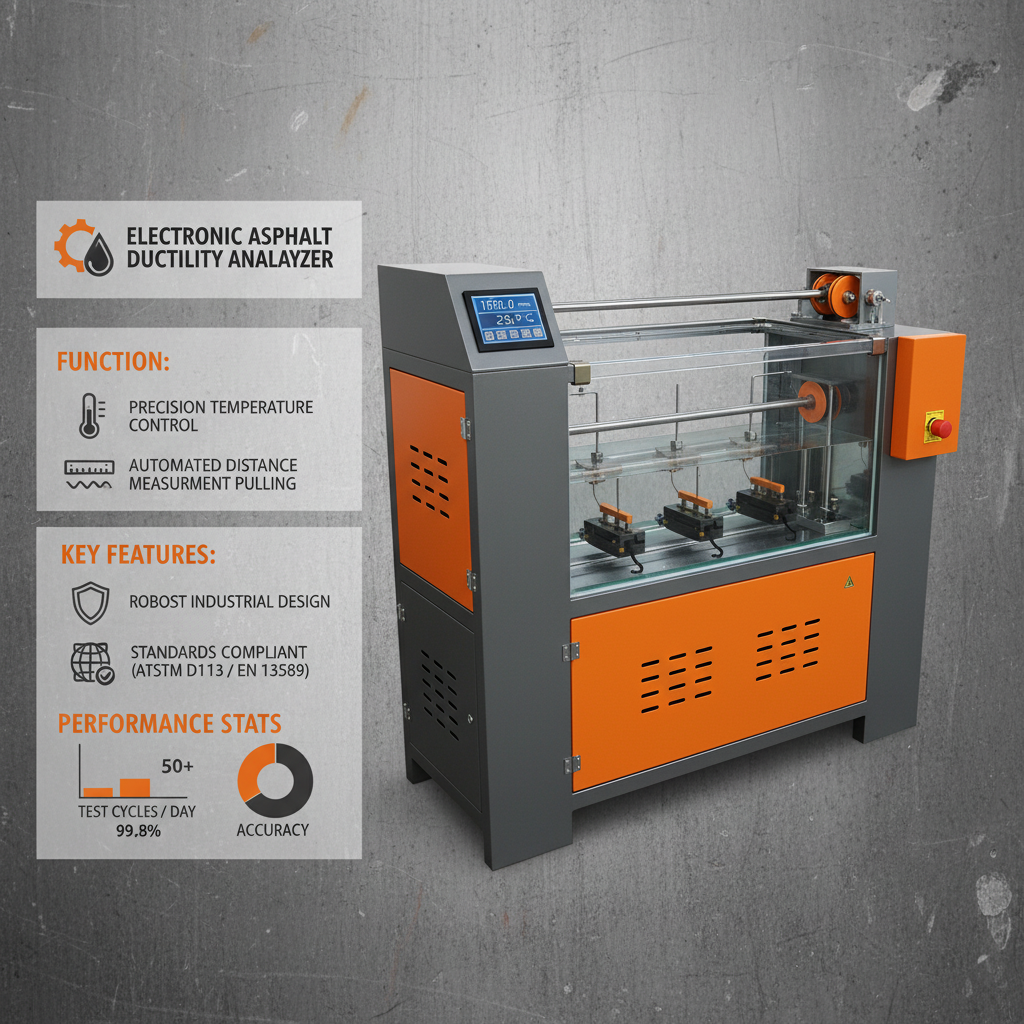
The quality and longevity of road infrastructure depend heavily on the rheological properties of the binders used, making the Electronic Asphalt Ductility Testing Machine an indispensable tool in modern materials science. By measuring the distance to which a standardized specimen of bitumen can be stretched before breaking, engineers can determine the elasticity and cohesion of the asphalt, which directly correlates to the road's resistance to cracking and deformation under heavy traffic loads.
Globally, the shift toward sustainable infrastructure and the integration of polymer-modified bitumens have increased the demand for high-precision testing. Traditional manual methods are often prone to human error and temperature fluctuations, whereas an Electronic Asphalt Ductility Testing Machine provides automated control and digital readout, ensuring that the results comply with strict international standards such as ASTM D113 and EN 13398.
Understanding the technical nuances of ductility testing allows laboratories to optimize mix designs, reducing maintenance costs and enhancing the safety of transport networks. This comprehensive guide explores the critical role of electronic testing systems in ensuring that our roads can withstand extreme climatic variations and the evolving demands of global logistics.

Global Industry Context of Asphalt Ductility Testing
In the current era of rapid urbanization, the World Bank and various international transport agencies have highlighted the critical need for resilient road surfaces. The Electronic Asphalt Ductility Testing Machine addresses a primary challenge in civil engineering: the failure of road binders due to temperature-induced brittleness. Without precise ductility measurement, roads in colder climates are susceptible to premature transverse cracking, leading to billions of dollars in annual repair costs globally.
The transition from manual to electronic systems reflects a broader industrial move toward "Industry 4.0" in construction materials. By implementing automated speed control and precise thermostatic baths, the Electronic Asphalt Ductility Testing Machine eliminates the variability introduced by human operators, allowing for standardized quality control across different geographical regions and laboratories.
Definition and Operational Meaning of the Testing Machine
An Electronic Asphalt Ductility Testing Machine is a specialized laboratory instrument designed to measure the distance in centimeters that a binder can be stretched before it ruptures, under specific temperature and speed conditions. Unlike its mechanical predecessors, the electronic version utilizes servo-motors and digital sensors to maintain a constant extension rate, typically 5 cm/min, ensuring that the viscoelastic properties of the bitumen are captured accurately.
At its core, the machine simulates the stretching forces that asphalt experiences during thermal contraction and expansion. This process is vital for humanitarian and developmental needs, particularly in emerging economies where building durable roads is the first step toward connecting remote villages to healthcare and markets. A high ductility value indicates a binder that can deform without breaking, which is essential for long-lasting highway pavements.
In modern industry, this machine serves as a "gatekeeper" for quality. Whether testing virgin bitumen, recycled asphalt pavement (RAP), or modified emulsions, the Electronic Asphalt Ductility Testing Machine provides the empirical data necessary to validate that a material meets the legal and safety requirements of national transport departments.
Core Components for Precision and Reliability
The precision of an Electronic Asphalt Ductility Testing Machine relies heavily on its temperature control system. A high-stability water bath is used to maintain the sample at exact temperatures (such as 25°C), as even a one-degree variance can significantly alter the ductility result, leading to incorrect material classification.
Another critical element is the electronic drive system. The Electronic Asphalt Ductility Testing Machine utilizes a high-precision stepper motor combined with an optical encoder to ensure the pulling speed remains constant. This automation removes the "jerking" motion often found in manual hand-cranked machines, which would otherwise cause premature specimen failure.
Finally, the digital measurement interface and sample holders play a pivotal role. Modern machines feature high-resolution LCD screens that automatically record the rupture point, while the holders are crafted from corrosion-resistant materials to prevent contamination of the bitumen, ensuring that the Electronic Asphalt Ductility Testing Machine delivers repeatable and auditable data.
Global Applications and Infrastructure Use Cases
The application of the Electronic Asphalt Ductility Testing Machine spans across various sectors, from government highway agencies to private petroleum refineries. In North America and Europe, it is used extensively to test "superpave" binders and polymers that are designed to withstand extreme freeze-thaw cycles. By analyzing the ductility, engineers can adjust the additive ratios to prevent rutting in the summer and cracking in the winter.
In remote industrial zones, such as mining sites in Australia or oil fields in the Middle East, the Electronic Asphalt Ductility Testing Machine is used to verify the quality of on-site mixed asphalt. In these harsh environments, the durability of the road surface is critical for the transport of heavy machinery; a failure in bitumen ductility can lead to road collapse, disrupting vital supply chains.
Comparative Performance of Asphalt Testing Methods
Long-Term Value and Economic Advantages
Investing in an Electronic Asphalt Ductility Testing Machine offers significant long-term economic value by reducing the risk of material failure. From a logical perspective, the cost of the machine is negligible compared to the cost of a road reconstruction project. By ensuring that the bitumen possesses the correct ductility, agencies can extend the service life of a pavement by several years, leading to substantial savings in public funds.
Beyond the financial gains, there is a profound impact on safety and sustainability. Roads that do not crack prematurely are safer for motorists and require fewer raw materials for repairs, which lowers the overall carbon footprint of the construction industry. The reliability provided by an Electronic Asphalt Ductility Testing Machine fosters trust between contractors and government inspectors, ensuring that infrastructure is built to last.
Future Trends in Digital Bitumen Analysis
The future of asphalt testing is moving toward full integration with Laboratory Information Management Systems (LIMS). We expect the Electronic Asphalt Ductility Testing Machine to evolve into a fully connected device that uploads results in real-time to a cloud database. This will allow engineers to monitor material quality across multiple project sites simultaneously, enabling a more agile response to quality deviations.
Furthermore, the integration of AI-driven predictive modeling will likely complement the data from the Electronic Asphalt Ductility Testing Machine. By combining ductility results with climate data and traffic projections, AI can predict the exact point of failure for a specific road section, transitioning the industry from reactive maintenance to proactive, predictive asset management.
Sustainability will also drive innovation, with a focus on testing "green" binders made from bio-based materials or recycled plastics. The Electronic Asphalt Ductility Testing Machine will be the primary tool used to validate that these eco-friendly alternatives can match or exceed the performance of traditional petroleum-based bitumen.
Common Technical Challenges and Expert Solutions
One of the most common challenges encountered with the Electronic Asphalt Ductility Testing Machine is the effect of sample preparation. Air bubbles trapped in the bitumen during pouring can create weak points, leading to artificially low ductility readings. To solve this, experts recommend a slow pouring technique and the use of a vacuum degassing chamber prior to testing.
Another hurdle is the maintenance of the water bath's homogeneity. Temperature gradients within the bath can cause the specimen to behave differently across its length. The solution is the implementation of high-efficiency circulation pumps and multi-point temperature sensors, which ensure that the Electronic Asphalt Ductility Testing Machine operates in a perfectly uniform thermal environment.
Finally, calibration drift in the electronic sensors can occur over time. Regular calibration against certified standard materials and the use of self-diagnostic software are the best ways to overcome this. By maintaining a strict calibration schedule, laboratories ensure that their Electronic Asphalt Ductility Testing Machine continues to produce results that are legally defensible and technically accurate.
Comparison of Ductility Testing Operational Factors
|
Analysis Dimension
|
Manual Testing
|
Electronic Testing
|
Impact on Result
|
| Speed Consistency |
Variable/Human-led |
Constant Servo-drive |
High (Eliminates surges) |
| Temp. Stability |
Passive Monitoring |
Active PID Control |
Critical (Prevents bias) |
| Data Recording |
Manual Log |
Digital Auto-save |
Moderate (Audit trail) |
| Operator Error |
High Probability |
Minimal |
High (Repeatability) |
| Setup Time |
Quick/Basic |
Moderate/Calibrated |
Low (Efficiency gain) |
| Standard Compliance |
Difficult to Verify |
Fully Compliant |
High (Legal acceptance) |
FAQS
The primary advantage lies in precision and repeatability. Manual machines rely on the operator to maintain a steady pull speed, which is nearly impossible to do perfectly. An Electronic Asphalt Ductility Testing Machine uses a servo-motor to maintain a constant speed (e.g., 5 cm/min) and an automated temperature bath, removing human error and ensuring that every test is performed under identical conditions, which is critical for meeting ISO or ASTM standards.
Temperature is the most critical variable in asphalt testing. Because bitumen is a thermoplastic material, its viscosity decreases as temperature increases. If the temperature in the Electronic Asphalt Ductility Testing Machine is too high, the sample will stretch excessively, giving a falsely high ductility reading. Conversely, if it's too low, the binder becomes brittle and snaps early. This is why high-precision electronic baths are essential.
Yes, the Electronic Asphalt Ductility Testing Machine is ideal for PMB. In fact, polymer modification is specifically designed to improve the ductility and elasticity of the binder. The electronic system is better equipped to handle the unique stretching characteristics of PMBs, providing a more accurate measurement of how the polymers reinforce the bitumen matrix compared to manual methods.
To ensure professional-grade accuracy, it is recommended to calibrate the Electronic Asphalt Ductility Testing Machine every 6 to 12 months, or after any major relocation of the equipment. Calibration should focus on the speed of the pulling mechanism and the temperature accuracy of the water bath. Using certified reference materials during calibration ensures that the lab's results are recognized by international regulatory bodies.
The most common cause of premature failure is the presence of air bubbles or impurities in the sample. Even a tiny void can act as a stress concentrator, causing the sample to rupture long before its actual ductility limit is reached. Other causes include improper specimen molding or temperature fluctuations within the Electronic Asphalt Ductility Testing Machine during the stretching process.
Absolutely. Most high-quality Electronic Asphalt Ductility Testing Machines are specifically designed to comply with ASTM D113 and EN 13398. These standards dictate the speed, temperature, and specimen dimensions. The electronic controls allow the user to select the specific standard they are testing under, ensuring that the results are valid for international tenders and government quality audits.
Conclusion
The Electronic Asphalt Ductility Testing Machine represents a critical intersection of precision engineering and infrastructure safety. By automating the measurement of binder elasticity and ensuring rigorous temperature control, it transforms a potentially subjective test into a reliable scientific metric. From reducing the risk of road failure to enabling the use of sustainable, modified binders, the adoption of electronic testing systems is essential for any laboratory committed to high-quality civil engineering.
As we look toward the future of smart cities and resilient infrastructure, the role of precise material analysis will only grow. It is highly recommended that road authorities and testing labs transition to electronic systems to ensure data integrity and long-term pavement durability. To explore the best solutions for your laboratory, visit our website: www.czlabinstrument.com.