
Comprehensive Guide to BET Surface Area Measurement and Its Applications
BET Surface Area Measurement: A Comprehensive Guide
Understanding the surface area of materials is crucial in numerous scientific and industrial applications, from catalysis and adsorption to pharmaceuticals and energy storage. BET (Brunauer-Emmett-Teller) surface area measurement is the gold standard for determining this critical property. This article provides a thorough overview of the BET method, its principles, applications, instrumentation, and how CZ Lab Instrument can assist you in achieving accurate and reliable results.

What is BET Surface Area Measurement?
The BET method is a widely used technique for determining the surface area of solid materials. Developed by Stephen Brunauer, Paul Emmett, and Edward Teller in 1938, it’s based on the physical adsorption of gas molecules onto the surface of a solid. By measuring the amount of gas adsorbed at different relative pressures, the total surface area can be calculated. This is a vital parameter in characterizing materials, as surface area influences reactivity, adsorption capacity, and other key properties.
The Principles Behind BET Analysis
The BET theory assumes that multilayer adsorption occurs. The first layer adsorbs strongly, followed by subsequent layers that adsorb with decreasing energy. By analyzing the adsorption isotherm – a plot of the amount of gas adsorbed versus the relative pressure – we can determine the monolayer capacity, which is the amount of gas needed to cover the surface with a single layer of molecules. From this, the total surface area is calculated using a specific formula. Accurate temperature control is essential, as it directly impacts the adsorption process.
Key Concepts: Monolayer capacity, adsorption isotherm, relative pressure, multilayer adsorption. Accurate temperature control is essential for reliable results.
Applications of BET Surface Area Measurement
BET surface area analysis finds applications across a broad spectrum of industries. In catalysis, it's used to characterize the active surface area of catalysts, impacting their efficiency. In materials science, it's crucial for understanding the porosity of materials like zeolites and activated carbon. Pharmaceutical companies use it to analyze drug particle size and dissolution rates. Furthermore, in energy storage, it's used to optimize electrode materials for batteries and supercapacitors. Understanding the surface area can greatly improve material performance.
Industry Applications:
• Catalysis: Optimizing catalyst activity.
• Pharmaceuticals: Drug formulation and delivery.
• Energy Storage: Improving battery and supercapacitor performance.
• Materials Science: Characterizing porous materials.
BET Surface Area Measurement Instrumentation and Technology
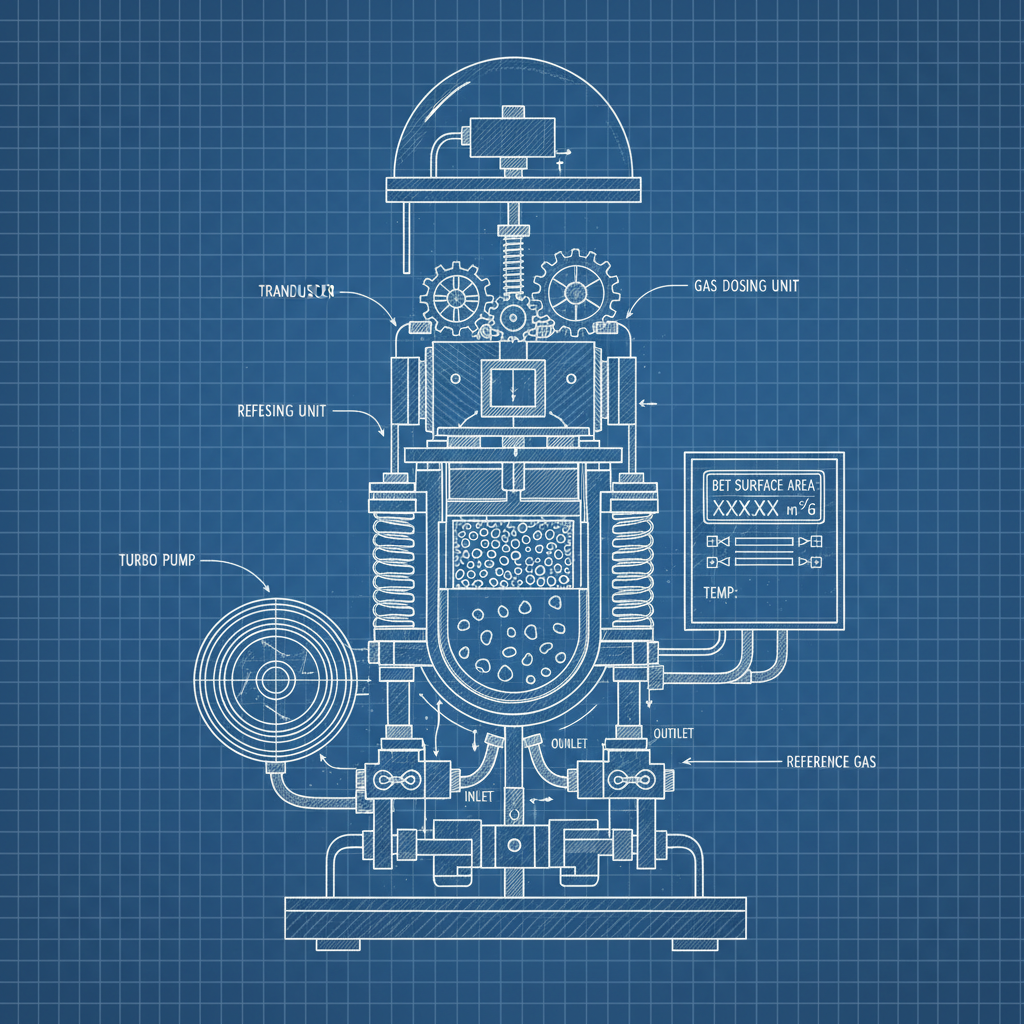
Modern BET surface area analyzers utilize automated gas adsorption systems. Nitrogen is the most commonly used adsorbate gas, although argon and krypton can also be employed. The process involves degassing the sample to remove any pre-adsorbed contaminants, followed by controlled exposure to the adsorbate gas at varying pressures and temperatures. The amount of gas adsorbed is measured using highly sensitive detectors. CZ Lab Instrument provides state-of-the-art BET analyzers known for their precision, reliability, and user-friendly interface.
Choosing the Right BET Analyzer: CZ Lab Instrument’s Solutions
When selecting a BET analyzer, consider factors such as automation, accuracy, sample versatility, and software capabilities. CZ Lab Instrument offers a range of BET analyzers designed to meet diverse research and industrial needs. Our instruments feature advanced degassing systems, precise temperature control, and user-friendly software for streamlined data acquisition and analysis. We pride ourselves on delivering reliable results and exceptional customer support.
Conclusion: Unleashing Insights with Accurate Surface Area Measurement
Accurate BET surface area measurement is paramount for optimizing material properties and driving innovation across countless applications. By leveraging advanced instrumentation and a thorough understanding of the underlying principles, researchers and industries can unlock valuable insights into material behavior. CZ Lab Instrument is your trusted partner in achieving precise, reliable, and actionable results.
Frequently Asked Questions (FAQs)
What sample preparation is required for BET analysis?
Proper sample preparation is crucial for accurate BET measurements. The sample must be thoroughly degassed to remove any adsorbed contaminants, such as moisture, air, or organic residues. This is typically achieved by heating the sample under vacuum. The degassing temperature and duration depend on the material being analyzed. For example, porous materials like zeolites require longer degassing times at higher temperatures to ensure complete removal of adsorbed species. Inadequate degassing can lead to overestimation of the surface area. CZ Lab Instrument provides degassing ovens specifically designed for optimal sample preparation.
What is the typical range of surface areas measured using the BET method?
The BET method can measure surface areas over a wide range, typically from 0.1 m²/g to over 1000 m²/g. Materials with high surface areas include activated carbon, zeolites, and metal-organic frameworks (MOFs). Lower surface areas are commonly observed in materials like polymers and metals. The specific range that can be accurately measured depends on the analyzer's sensitivity and the characteristics of the sample. The data quality and accuracy are essential factors to consider when interpreting surface area results.
How does particle size affect BET measurements?
Particle size can influence the accuracy of BET measurements, particularly if the particles are too large or not uniformly distributed. Larger particles may lead to less efficient gas adsorption due to diffusion limitations. Non-uniform particle sizes can affect the reproducibility of the measurements. Therefore, it's important to ensure the sample has a narrow particle size distribution and is properly dispersed in the sample holder. Sieving and milling can be used to achieve optimal particle size distribution prior to analysis.
What are the limitations of the BET method?
While the BET method is widely used and reliable, it has some limitations. It assumes multilayer adsorption and ideal gas behavior, which may not always be true, especially at high pressures. The method is also sensitive to the presence of micropores (pores smaller than 2 nm), which can lead to deviations from the BET equation. For materials with significant microporosity, other techniques, such as density functional theory (DFT), may be more appropriate for accurate pore size and volume determination.


